
Best Gaming Motherboard 2026: AM5 vs Z890 Guide
AMD AM5 or Intel Z890? Our 2026 gaming motherboard guide picks the best boards at every budget before you commit to a platform.
PC HARDWAREBUILD GUIDES
7/9/20265 min read
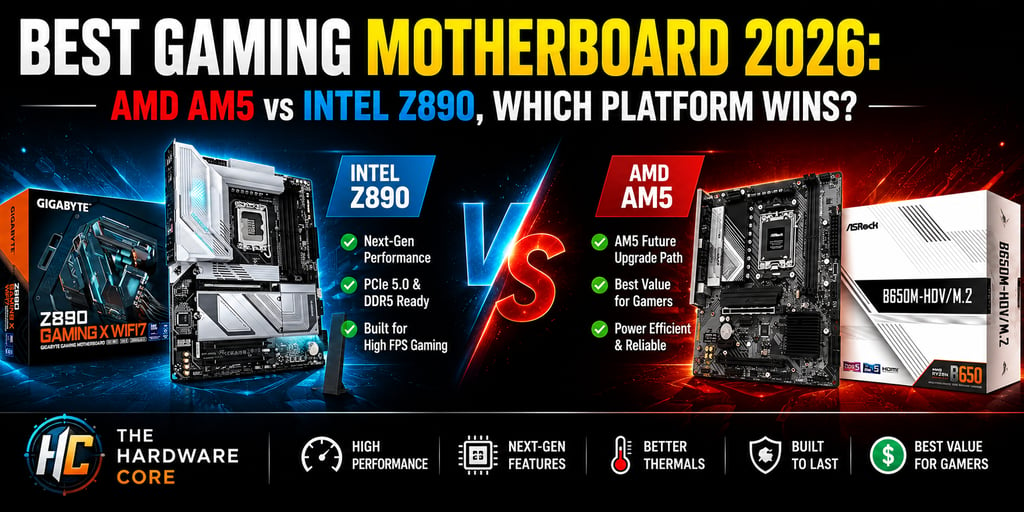
Best Gaming Motherboard 2026: AMD AM5 vs Intel Z890, Which Platform Wins?
This post contains affiliate links. If you purchase through these links, The Hardware Core may earn a small commission at no additional cost to you. This never influences our recommendations.
Picking a motherboard in 2026 isn't just about features on a spec sheet. It's a platform commitment, the decision you make here dictates what CPU you can run, how long your system stays relevant, and whether you'll be spending again in two years or five. Get it wrong and even the best GPU can't save you.
We cover the full breakdown of both platforms on The Hardware Core YouTube channel, but this guide gives you the detailed spec analysis and buying recommendations you need before you pull the trigger.
The short version: AMD's AM5 platform is still the safest long-term bet for pure gaming builds, while Intel's Z890 is the stronger option if you're splitting time between gaming and serious content creation workloads. Here's exactly why.
AM5 or Z890? Picking the Right Platform Before You Buy Anything
This is the decision that should come before you even look at a specific board. Both platforms support DDR5 and PCIe 5.0, so on paper, they're comparable. The real difference is longevity and focus.
AMD officially extended AM5 socket support through at least 2029. That matters more than most people realize. It means the board you buy today will accept next-generation Ryzen processors without requiring a new platform purchase. If you're building for the long haul and plan to upgrade CPUs every two or three years rather than rebuilding from scratch, AM5 is the obvious financial choice.
Intel's LGA 1851 and Z890 chipset is a refined, highly capable platform, but Intel has historically cycled through socket changes more aggressively. It's not a reason to avoid Z890, but it is a reason to factor it into your total cost of ownership calculation.
What to choose:
Best for gaming-focused long-term builds: AMD AM5, the longevity guarantee is real and the Ryzen 9000X3D lineup proves the platform still has headroom
Best for gaming plus heavy content creation: Intel Z890, disaggregated tile architecture handles mixed workloads exceptionally well
Best for budget builders: AMD B850, gives you the AM5 platform benefits without the Z890-level premium
Before settling on a chipset, make sure you've locked in your CPU choice first, your processor pick should drive the platform decision, not the other way around. Our breakdown of the best gaming CPU in 2026 walks through exactly which chips are worth building around right now.
The Best AMD AM5 Motherboards for Gaming in 2026
The AM5 lineup has matured significantly. You're not paying an early-adopter tax anymore, there are genuinely excellent boards at every price point, and the ecosystem is fully fleshed out.
Platform/Chipset: AM5 / X870E
VRM Configuration: 18+2+2 phase, 110A power stages, handles even the most demanding Ryzen X3D processors without throttling
Memory Support: DDR5 up to 8400 MT/s natively, with CUDIMM compatibility pushing further with EXPO tuning
Connectivity: Dual USB4 40Gbps ports, Wi-Fi 7, 10GbE LAN, four M.2 slots with two running PCIe 5.0
Best For: Enthusiasts who want X3D Turbo Mode 2.0 support and the headroom to tune memory aggressively without hitting a wall
The Catch: Premium pricing, you're paying for every feature, so don't buy this if you're not using them
Platform/Chipset: AM5 / X870
VRM Configuration: 16+2+1 phase, 90A power stages, more than adequate for Ryzen 7 and Ryzen 9 series without X3D extreme thermals
Memory Support: DDR5 up to 8000 MT/s, Wi-Fi 7, 2.5GbE LAN, two PCIe 5.0 M.2 slots
Best For: The sweet spot buy, you get nearly all the X870E features at a noticeably lower price point
The Catch: The single 10GbE LAN step-down from the flagship matters if you're on a home network that can saturate gigabit
The MSI MAG X870 Tomahawk is the platform anchor for the $1,500 build tier. Our $1,500 gaming PC build guide for 2026 shows exactly how it pairs with the Ryzen 7 9800X3D and RTX 5070.
Gigabyte B850 AORUS Elite WiFi
Platform/Chipset: AM5 / B850
VRM Configuration: 14+2+2 phase, 75A power stages, built for Ryzen 5 and Ryzen 7 without the overkill overhead
Memory Support: DDR5 up to 7600 MT/s, Wi-Fi 6E, 2.5GbE, two M.2 slots with one PCIe 5.0
Best For: Budget-conscious AM5 builders who still want platform longevity without compromising on build quality
The Catch: B850 limits some overclocking headroom versus X870, if you're planning to push a high-end X3D chip, step up
If you're pairing any of these boards with a high-TDP processor, don't overlook your power supply. Running a Ryzen 9000X3D at sustained load on a marginal PSU is a real problem, our best ATX 3.1 PSU guide for 2026 covers exactly what you need to support a high-performance AM5 build safely.
The Best Intel Z890 Motherboards for Gaming in 2026
Z890 boards are built for performance without compromise. The VRM phases are heavier, the power delivery is more refined, and the high-end options are frankly overkill for gaming alone, which is exactly why they're the right call if your workload extends beyond it.
Platform/Chipset: LGA 1851 / Z890
VRM Configuration: 24+1+2 phase, 110A power stages, purpose-built for extreme overclocking and memory tuning
Memory Support: 2-DIMM layout specifically designed to hit DDR5 frequencies above 9000 MT/s with CAMM2 compatibility on revision boards
Connectivity: Dual Thunderbolt 4, USB4, 10GbE LAN, five M.2 slots including three PCIe 5.0
Best For: Overclockers and memory enthusiasts, the 2-DIMM topology is the cleanest signal path available on a consumer platform right now
The Catch: Expensive, large, and loaded with features most gamers will never use. Don't buy this for casual gaming.
Platform/Chipset: LGA 1851 / Z890
VRM Configuration: 20+1+2 phase, 105A power stages, handles Core Ultra 200S without breaking a sweat under sustained gaming and rendering loads
Memory Support: DDR5 up to 9200 MT/s, Wi-Fi 7, dual 10GbE LAN, four M.2 slots with PCIe 5.0
Best For: Creators and streamers who game heavily, the dual 10GbE LAN and Thunderbolt 4 connectivity make this a genuine workstation-class board at a more approachable price than the Apex
The Catch: The dual 10GbE premium is real, you're paying for infrastructure most home setups can't take advantage of
Platform/Chipset: LGA 1851 / Z890
VRM Configuration: 16+1+2 phase, 80A power stages, well-matched for Core Ultra 200 mid-range SKUs
Memory Support: DDR5 up to 8600 MT/s, Wi-Fi 7, 2.5GbE, three M.2 slots
Best For: Gamers who want Z890 capabilities without the flagship price — strong feature set, clean layout, and reliable VRM cooling
The Catch: If you're planning to run a Core Ultra 9 285K at sustained all-core loads, consider stepping up for more VRM headroom
One thing worth knowing regardless of platform: if you're building on a board that supports CAMM2 memory (a growing number of Z890 enthusiast boards do), the upgrade calculus changes significantly. Our Desktop CAMM2 vs DDR5 breakdown covers whether it's worth the platform premium for your specific use case.
The board handles power delivery and memory routing. Our Windows 11 gaming optimization guide for 2026 handles the OS configuration side that determines how efficiently that hardware performs in actual games.
Once you've chosen your board, our PC building guide for 2026 covers the exact installation steps for both AM5 and LGA1851 platforms so you know what to expect on build day.
The Verdict
Don't let the feature lists overwhelm you, the motherboard decision comes down to what you're building for and how long you need it to last.
Go AMD AM5 if gaming is your primary workload and you want platform longevity without paying an ongoing upgrade tax. The B850 hits the value sweet spot; the X870E is there when you want headroom.
Go Intel Z890 if you're a creator-gamer hybrid or you plan to push extreme memory overclocks. The platform is refined, powerful, and the top-end boards are genuinely special pieces of hardware.
Either way, don't cheap out on the board just to spend more on the GPU. A weak VRM on a strong CPU is a bottleneck you'll feel. You also need to consider cooler clearance and VRM airflow compatibility as well as case compatibility and back-connect motherboard support.
Our current top motherboard pick, and every other component we recommend, is on the Gear We Recommend page.
Rounding out your budget? Our Market Tracker has current verified GPU and memory pricing.
Connect
Stay updated with the latest hardware insights
Contact
Subscribe
contact@Thehardwarecore.com
© 2026. All rights reserved.
THE BASEMENT

